
Getting It Right
Lest you think more highly of me as an artist than you should, I have to set the record straight. The photographs you see in my galleries are the cream of the crop of my pysanky. What you don’t see are my less than successful endeavors.
Sometimes it’s not my fault. Sometimes the eggshell is damaged in a way that doesn’t show up until near the end of the process. That’s why I don’t use grocery store eggs anymore. Mechanical rollers leave invisible scratches on mass produced eggshells. It’s very disheartening to put hours of work into an egg only to discover on the final dye that imperfections mar the design.
Lots of times, though, it is definitely my fault. I have mistakenly covered areas in wax when I shouldn’t have. I’ve forgotten to cover areas with wax when I should have, which means they end up a different color than I had originally planned. I have also dyed the whole egg the wrong color and there is no “undo” button for that.
Even finishing an egg isn’t any guarantee of success. More than once I have bobbled an egg just as I was taking off the final bits of wax. Sometimes they bounce on the table and stay whole, but twice I accidentally crushed the egg between my stomach and the table edge while trying to keep it from falling. And you can’t put Humpty Dumpty together again.
The most irritating of all are mistakes I make from inattention or impatience. Last year I was in a hurry because of a close deadline so I put the egg in an oven with the light on, thinking the warm air would  help it dry faster. I foolishly thought the light would also warn my boys to remove the egg before preheating the oven. They didn’t and there is no “undo” button for a burnt, browned egg either. Trust me.
The photos here show a simple project that turned endless. On the first egg you can see some unattractive dye imperfections from hen scratches. So I tried again. The second e gg burned when the tissue I was using to wipe the wax from the egg caught on fire. Egg number three turned out better than the previous two attempts but I was nervous the whole way through the process.
Whatever the reason for these mistakes, there is something to be said for the character quality of persistence. And that’s what God is teaching me through this art these days.
But I Repeat Myself
I think I have a high tolerance for repetition. Doing the same things over and over is just part of my job as a mom. Every day the beds must be made (mine, not the boys’s…I gave up on that a long time ago), dishes need cleaning, meals prepared and on and on it goes. There’s weekly laundry and floor cleaning, and monthly chores. Add spring cleaning and fall leaf raking. The list goes on. It’s a never ending cycle of tasks that keep repeating over and over, year in and year out.
I’d be lying if I said it never bothers me, but most of the time it just is, and I keep moving forward to getting  one more thing done for the day. I never thought much about it before but one of the key aspects of the art of pysanky is the way designs repeat over and over on a single egg. The beauty of the finished egg has a lot to do with its symmetry and the comforting cycle of patterns stretched over the constantly changing curve of the egg. This repetition not only gives the viewer something predictable to expect and enjoy but it also gives the artist a chance to get it right through practice.
As an artist, if I never have to repeat anything, I never get to improve my technique, refine my hand/eye coordination, expand my use of color, or give free flight to my imagination. Repetition can be a prison if I allow it to, but it can also be a teacher and a friend…in art and life as well.
The Beauty of Slow
While working on my website yesterday I saw an announcement asking if I’d like to “get posts sent directly to you via instant messenger” and that started me thinking. Just how fast do I need to get posts? I mean, do I really need to know instantly when a new post is out there for me to read?
No one would deny that we live in a fast-paced world. Everything today is fast… email and instant messaging make the postman unnecessary… microwaves cook our food in minutes…online shopping can have your purchase on your doorstep overnight…digital photos go instantly from camera to computer to printer…and the list goes on. We just don’t know how to slow down anymore. Nor do we want to.
 It feels like life speeds up with each passing year and there’s no way to stop it. And yet I find I crave the slowness found in the art of pysanky. Everything about it is slow, from melting the beeswax in the kistka to waiting as the egg sits in the dye to working layer by layer, color by color toward the finished egg. My soul grows bigger as I watch a design emerge, wrapping another egg in elaborate colors.
This is where slow is beautiful. And that’s a good thing.
The Artist in Community
Truth be told, I love stealing away to my workspace alone, leaving the rest of the world behind as I immerse myself in the work and play of wax and dyes and eggs. There is something healing and soul restoring about the quiet, repetitive actions these eggs require. I can’t seem to get enough time alone like this so when I do, I enjoy it thoroughly.
 Interacting with other artists is just as valuable to my soul, yet I don’t make nearly enough time for it in my life. Why is it so hard for me? I understand the value of community, I enjoy learning about the art and soul journeys of others, and I get inspired when I hear other artists speak with passion about their art.
I realize I love my comfortable “alone” zone so to push against these introverted leanings, I meet monthly with other artists. In the Sacramento area, the Covenant Artists meet on the third Thursday of each month and artists of all media and skill levels are welcome. This group exists to share, discover, and learn about ourselves, our art and our God.
If you would like to stretch your artistic side, I highly recommend connecting with other artists. Isn’t it time for you to step out of your comfort zone too?
A Miniature World
It’s a mystery to me that I can pick colors and create intricate designs on a tiny egg without a problem but when it comes to decorating my house, I am clueless. I have friends whose homes are beautifully color coordinated with wall hangings, knickknacks and furniture. They truly have the home decorating gene and it’s awesome to experience. I, on the other hand, have realized that if the area to be decorated is larger than about six inches, I have no idea where to start or what to do.
 I’ve always loved miniature things. As a child, I delighted in making tiny items for my beloved troll dolls. A toothpaste cap became a bucket while pieces of string turned a toothpick into a mop. My shoebox dollhouse had “real art” on its walls made from wooden matchstick frames and small magazine clippings. When I learned to knit I created many mouse-sized stocking caps just for the fun of it.
Even now as I analyze what gives me pleasure I can see that I lean toward the little every time. Baby birds…well just about baby anything for that matter…miniature flowers versus their larger cousins… hummingbirds with their teeny tiny feet…1000 piece puzzles… cross-stitch patterns designed for 22 stitches-per-inch fabric…very petite Christmas ornaments…you get the idea.
So I take my hat off to those of you who enjoy working in larger slices of life. You have a talent I greatly admire but I think I’ll stay in my miniature world. And you’re welcome to come visit me anytime.
I Hate Orange
I don’t know why, but I hate the color orange. Intellectually I know a world without orange would be boring, but given a choice,  I’ll pick any other color over orange. Even as a kid, I remember my orange crayon would remain in the box, tall and pointed, while the blue crayon wore down to a nub quickly. I don’t wear orange clothing, there is no orange inside my house and when I see orange in Fall decorations, I grit my teeth and try to remember that Christmas reds and greens will replace it soon enough.
This aversion creeps up more often than you’d think. A few years ago my husband, Dave, and I were choosing plants for our new back yard. When the landscape designer asked about our color preferences Dave responded “lots of color, all kinds,” while I said, “anything except orange.” Being the old married couple we are, we came to a compromise—bright orange goldfish in the pond but no orange flowers in the yard.
As a result of this dislike I tend to avoid orange in my art, a fact I did not realize until recently while going through some of my egg photos. When I compared color choices and looked at a wide variety of examples from other pysanky artists I saw what a difference it can make. I’ll even admit that orange can add welcome contrast and depth at times.
I still don’t like orange but if I want to grow as an artist I have to stretch beyond myself and experiment with new things, even the color orange. So I’ll try…if I have to…I guess.
Pysanky Demo at Bella Fiore Florist
Saturday August 14 from 5 to 9 PM— Enjoy the relaxed atmosphere of the Second Saturday experience in Fair Oaks Village and be sure to stop by Bella Fiore Florist to see firsthand the painstaking work that goes into creating these eggs.
 Personally, I really enjoy the opportunity to explain how I make pysanky (Ukrainian eggs). Most people are unfamiliar with the wax-resist process and find it hard at first to envision the steps it takes, layering wax on the eggshell as it is dyed color after color. The fun part for me at these demonstrations comes when that light bulb of understanding dawns and the onlookers grasp the whole concept.
Bella Fiore’s owners, Bill and Debbie, have transformed part of their shop into an art gallery where you can see some of my pysanky as well as works by other local artists. Take some time on this Second Saturday to explore and enjoy this wonderful venue.
Lifelong Learning
Several years ago my sister and I attended a weeklong class on artisan bread-baking at the John C Campbell Folkschool in Brasstown, North Carolina. It was kind of like summer camp for adults, except that the setting was spectacular, it runs year round and the food is a whole lot better. Their website states they “provide experiences in non-competitive learning and community life that are joyful and enlivening” and I can say firsthand they certainly met that goal.
As I absorbed the atmosphere that week, attended class or extra activities, and enjoyed conversations with other campers during our communal meals, I realized that we tend to relegate learning to the young. Once we graduate from high school, or college, or beyond we don’t always give ourselves the permission to explore new things, to try and possibly fail, or to devote time and energy to an endeavor just for the fun of it. During that week I talked with many fellow students who were discovering a passion for some new art that they had never known before. How sweet to see eyes light up as they talked about their class and their projects.
 On a more personal note, at the grand old age of 50, I picked up the cello for the first time. I can honestly say it has been challenging, fulfilling, frustrating, and beyond fun. My point here? There is never a “too late” when it comes to learning something new.
If you are interested in learning how to make these pysanky eggs, the next introductory class will be Saturday, August 21, from 9 AM to 12 PM. You don’t need to bring anything, or know anything, or have any artistic talent. You just need to come with a youthful curiosity. See the “Classes” tab above for more information.
Unexpected Extras
Here’s a simple truth. Life doesn’t always go as planned…and the same thing applies in cr eating these eggs. I can’t tell you how many times I’ve started with an idea in my head and then proceeded to do it differently on the egg. Perhaps more often I forget to cover an area with wax and don’t discover it until after the egg comes out of the next darker dye when it’s too late to change anything. That’s what happened on this cross in the photo to the right.
 Sometimes I desire a specific color and the egg just won’t take the dye properly so the color scheme changes completely. The egg to the left was supposed to have brilliant clear colors, but instead looks like an ancient, well-loved quilt which I liked even better. In my family we call that experience an “unexpected extra.”

 These photos show two eggs dipped in the same dyes for the same amount of time but ending with totally unique colors. Certainly not what I had planned when I started.
I admit it irritates me at times, but that’s part of the beauty of this art. It can be wonderfully unpredictable which means sometimes the results are more surprising and spectacular than if it had turned out the way I planned. A kindergarten teacher my boys had would always say, “You get what you get and you don’t throw a fit.” As I think about it, that applies to creating these eggs but it’s also a pretty good philosophy for life as well.
Step by Step
When people see these eggs for the first time, they often assume I’ve painted them. In reality I use a wax-resist process. “A what?” is the next question I hear. And “Is it hard?” closely follows.
To answer both these questions let me take you step by step through this process.
 With a kistka (a small copper funnel on a stick) I apply melted beeswax lines to the egg. All areas covered by this first layer of wax will remain white on the finished egg.

Next, I dye the whole egg yellow and draw more wax lines to preserve the yellow color. Green dye must be painted in small areas and then covered with wax.

Now the egg receives an orange dye bath. Anything that should stay orange on the finished egg must be covered with wax.

After the red dye bath, the egg is ready for another layer of wax to protect everything that will remain red.

The final dye color on this egg is black.
To reveal the finished design, I remove the wax by holding the egg near a candle flame and wiping off the wax as it melts.

Several layers of glossy varnish protect the design and complete the process
With just a few simple tools and a lot of time and patience, these colorful eggs really come to life.
Arts Camp 2010
 How can I describe the amazing experience we call Arts Camp at Oak Hills Church. You just had to be there. The air tingles with high energy and excitement as 360 first through sixth graders plus over 100 adult and student helpers explore all forms of art. Everywhere you go on campus you see kids in their classes learning dance, drama, music, painting, silk screening, woodworking, even the culinary arts and lots more.

For the second year now, I had the privilege of teaching ten fifth/sixth graders how to create pysanky eggs. It’s always a little scary to combine kids and candle flames but thanks to plenty of supervision and a couple of mini fire drills, we had no major mishaps. Most of my students managed to finish at least three eggs over the course of this week. And more than that, I could see  that they really understood the step by step process as they designed and completed projects on their own.


 The techniques as well as the historical significance of pysanky have been handed down through the ages from parent to child, from teacher to student, from one generation to another. And now, I’m proud to say, a new generation of pysanky artists is well on its way to carrying on this tradition.

It’s About Time
 I recently had my son and resident photographer, Ryan, take some egg photos for me. As he set up his camera, I collected eggs from their various resting spots around the house and together we staged shots that filled the photos with masses of eggs. Looking at the end result now I marvel at how many finished pysanky there are.
People often ask me how much time it takes to make one of these eggs. It’s hard for me to estimate because I enjoy it so much, but it can range from two hours for a very simple chicken egg to nearly forty hours for a large, multi-colored ostrich egg. And that’s just actual time working on the eggs. It doesn’t include the hours spent daydreaming about the next egg or figuring out a design problem in my head or sketching ideas into my notebook. All I can say is that individually they take a lot of time, but collectively it’s astronomical.
I’m amazed at the amount of time those eggs represent over these last fifteen years. And grateful for the life I have—a husband who supports me in my art and doesn’t mind eating Cheerios for dinner when I’m madly at work in my studio, three nearly grown boys who can operate pretty independently most of the time, a church that fully embraces the arts and the artists within, and a God who gave me this passion for creating beauty in small spaces. Life is good indeed…and it’s about time I stop and remember that.
Starting Over
 A gallery show has a lifecycle of its own. First comes the spark of an idea…and then hours or days of contemplating the possibilities, working out the plan in my mind. Soon I’m taking a few first steps of actual work on the eggs. This is the fun part. Yes, this will work! I am convinced I can do it. More quiet hours at my desk steadily applying fine lines of wax or waiting patiently for the dye color to be just right. This is going to be a wonderful show, I can tell already.
Usually about midway into the process come the first seeds of self-doubt. Are my designs strong enough? Did I choose the right theme? Can I complete enough work in this theme? Will I finish enough eggs by the deadline? What if I can’t do it? Am I really an artist or am I fooling myself? What if I don’t make the deadline? Should I just give up now? Why did I ever agree to this gallery? What am I doing on this earth?
Okay, take a breath, I remind myself. You can do this. Remember to focus on one egg at a time. One line at a time. The work continues, slowly but surely. As the deadline looms ever closer I realize I’m going to make it after all. The completed eggs silently cheer me on and even in the final frenzy of setting up the show with all its time consuming details, I feel a mystifying satisfaction. I know deep in my soul that I am an artist because God created me that way. And it is good.
Now to start my next show.
Getting the blog going
 Practice, practice, practice!
New Show at Art & Soul Gallery
Lent:Reflections in Black and White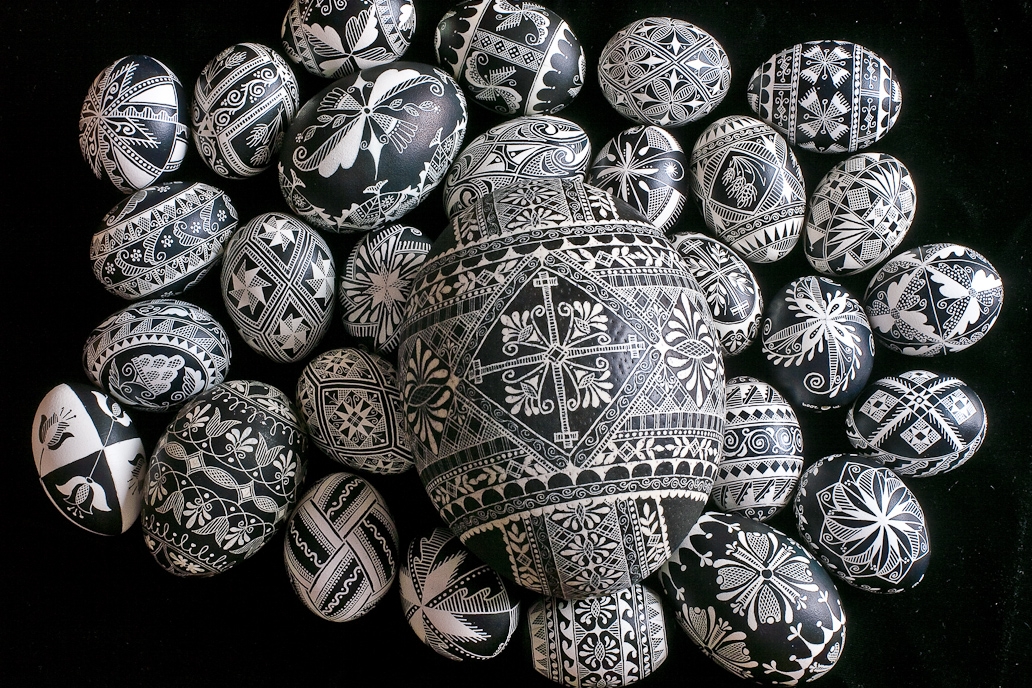
February 21-April 18, 2010
Art & Soul Gallery
Oak Hills Church, Folsom, California
Lent is a time of preparation for the Easter celebration of Christ’s Resurrection. Historically the Church sets aside the forty days of Lent for fasting and prayer, imitating Christ’s forty day experience in the desert. Lent is a time of waiting. It is a season for reflection and taking stock. A time of soul-searching and repentance.
Connecting my artistic passion with my life in Christ has given me a whole new depth of awe and wonder about God, my Creator and Savior. As I contemplated this project, the first question that came to mind was, “How do I link this highly symbolic art with the season of Lent?”
Beginning with prayer and trepidation, I challenged myself to work only in black and white. Without the distraction of color, each design must truly stand on its own. I also experimented with a wide variety of designs, from simple to complex. The time it took to create each piece provided a refreshingly quiet space to contemplate this season’s purpose.
Exploring the Lenten Season through the art of pysanky has not only stretched me as an artist, it has given me a new appreciation for the history and the practice of Lent. As you wander through the gallery, take your time…slow down…and let this season sink deep into your soul as well.
Teresa Mihalko Harbert—Pysanky Eggs
Ryan Harbert—Photography


